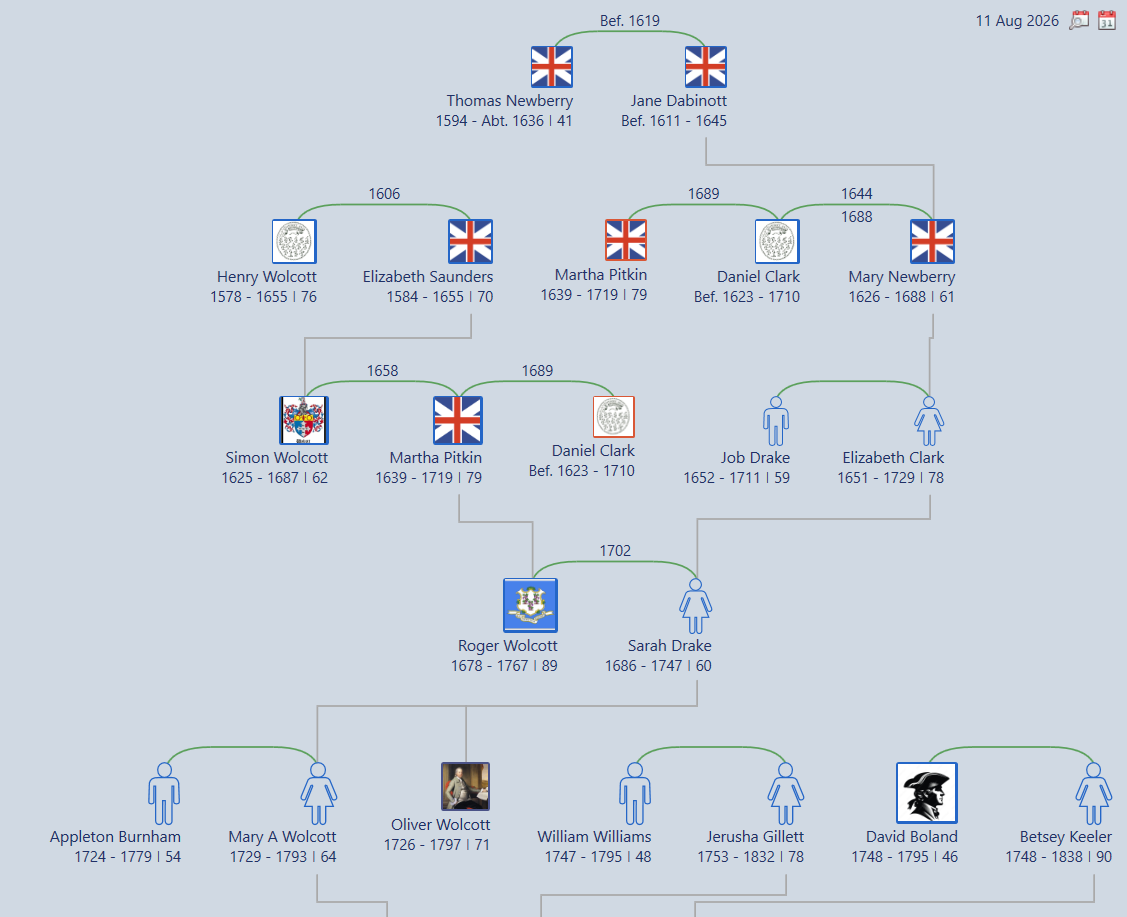
Nana (Ethel Carlson Lavieri) is from a family with deep roots in Connecticut. Her first ancestors came to North America in 1630 on the Mary and John — only 10 years after the Mayflower landed in Plymouth. Thomas and Jane Newberry (Nana's 8th Great Grandparents) and their 4-year-old daughter Mary (Nana's 7th Great Grandmother), along with Henry and Elizabeth Wolcott (Nana's 7th Great Grandparents and financers of the voyage), departed from England and landed on Nantasket beach in Hull on May 30, 1630, after an uneventful passage. There were only 140 passengers on board this ship, but 5 of them, from two different families, are related to Nana. 350 years later, Rob and Kathy Lavieri would live at 777 Nantasket Ave in Hull. That beach is the first North American ground Nana's ancestors walked on, a little less than 400 years ago. Their ship was loosely associated with an 11-ship flotilla led by John Winthrop, Massachusetts Bay Colony Governor. From the beach they all made their way to an area south of present-day Boston and founded the town of Dorchester.
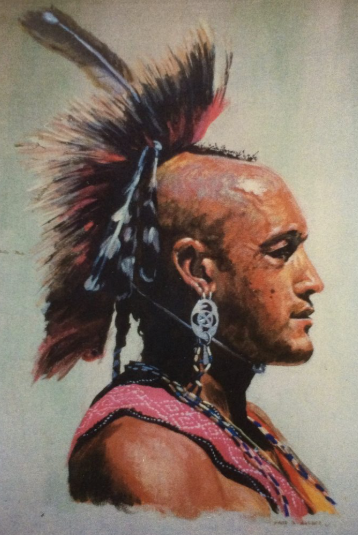
In 1631, Wahginnacut, the Mohegan sachem from the Connecticut River valley, paid a call on the governors of the Massachusetts and Plymouth colonies to "sell" them on the idea of establishing a white settlement in the Connecticut valley. He described the abundant wildlife and fertile land and proposed the opportunity for trade in commodities such as corn, beaver and otter skins. He also pledged an annual gift of a full supply of corn and 80 beaver skins to the whites who would settle in the valley.
Massachusetts Governor Winthrop declined the offer, but Plymouth Governor Winslow consented to go with Wahginnacut, in company with William Bradford, to look at the paradise the sachem had described. The sachem showed his guests the rich land on a tour and validated what he was offering. What Wahginnacut did not mention was the distress and alarm being experienced by most of the Connecticut River tribes, who were being attacked by the Pequot tribe and driven from the area. Wahginnacut hoped that the presence of an English settlement would serve as protection and defense against their dreaded enemies.
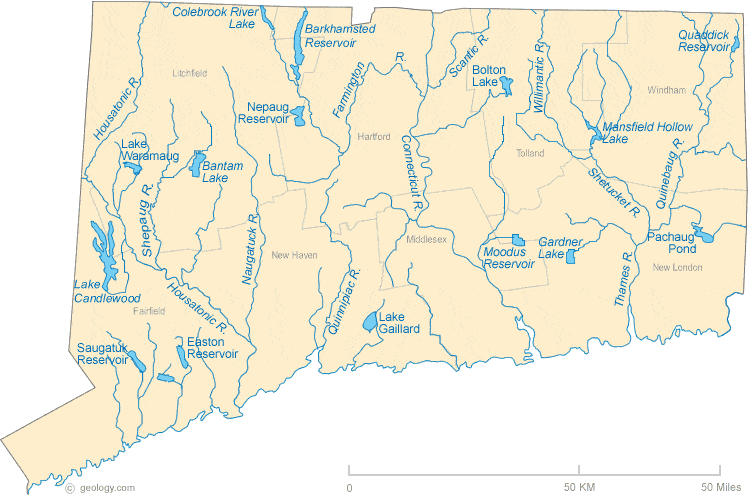
Nonetheless, in October 1635, about 60 of the original group of 1630 immigrants traveled overland to where the Farmington and Connecticut rivers meet, while their provisions were sent by ship from Dorchester up the Connecticut river. The settlers arrived, but the ship never did. The Mohegan Indians demonstrated the sincerity of their invitation by feeding and housing the settlers through the winter so they could establish the town of Windsor. Henry and Elizabeth Wolcott (Nana's 7th Great Grandparents) came the next year and fortunately avoided that fiasco. In 1639, Daniel Clark (Nana's 7th Great Grandfather) arrived in Windsor, and sometime during this period Mary Newberry — that little 4-year-old on the Mary and John, now a teenager — traveled to Windsor as well. She would marry Daniel Clark in 1644.
This is how Nana's ancestors came to the Connecticut river valley — but there is one slight catch: it wasn't Connecticut yet. Not until two decades later, in 1662, did King Charles II of England issue a Charter that created the Connecticut Colony. The Charter lists 19 men as petitioners and grantees. Nana is a direct descendant of at least two of the men listed — Daniel Clark and Henry Wolcott, who are both her 7th Great Grandfather.
A short note about Daniel Clark: he is called the "great grandfather of governors" because at least 5 governors of Connecticut and Massachusetts descended from him. Also, when his wife Jane died, he married Martha Pitkin Wolcott, who was Roger Wolcott's mother — which is why this section of the family tree looks a little odd, with his name and others' repeated in the chart above. At the bottom of this section of Nana's family tree you can also see David Boland (Nana's 4th Great Grandfather), the Revolutionary War patriot whom her Daughters of the American Revolution (DAR) membership is tied to.
This story was lost to history until Frank uncovered it in 2026. Nana did not know that her first ancestors founded Connecticut, that she was related to at least two Connecticut governors, or that she was related to Oliver Wolcott, who signed the Declaration of Independence. How is this possible? She grew up in Connecticut, and Oliver Wolcott is one of the most famous sons of the state. Wouldn't you think that her parents and grandparents would have told her these stories?
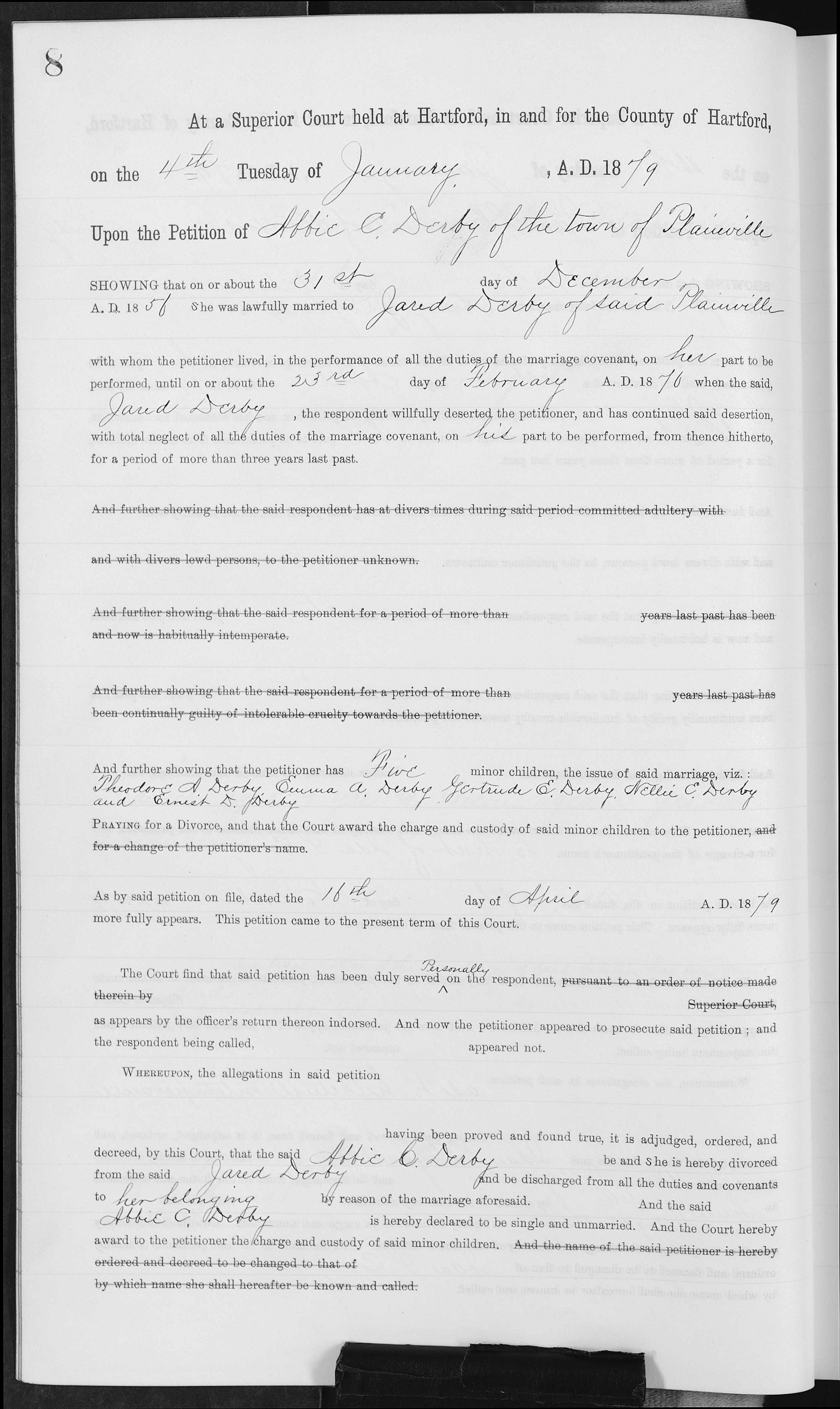
Her parents and grandparents never told her these stories, I believe, because they didn't want to tell her the truth about her grandfather Theodore Derby. Open up our family tree and find Theodore Derby (1858–1930) — he has a picture of a locomotive engine in the box above his name. He died two years before Nana was born, so she never met him, but her grandmother Derby (Martha, 1865–1948) lived until Nana was 16 years old, and they knew each other. Nana was told that Theodore grew up in a castle in England and had servants who did everything for him, and that as a result he didn't have many skills, which was why he became a baggage handler at the train station. They chose to tell her this story to hide the fact that Theodore's parents, Jared and Abbie Derby, were divorced in 1879. It seems trivial to us today, but back then divorce carried a real taboo and social stigma. It was so rare that their divorce had to be granted by the Superior Court in Hartford.
Why did they divorce? I can't be sure, but what makes sense to me, based on what few facts I've seen, is that Abbie came from the wealthy industrialist family of hat factory owner William Burnham (1802–1868), while Jared came from a more hardscrabble life — his mother lived in the Middletown poorhouse for over 20 years after his father died. Jared's only fault may have been that he wasn't a good provider: he's listed in censuses as working out of his home workshop and may not have had steady income. Abbie likely relied on support from family members to raise her children after separating from Jared. In any case, Jared and Abbie had 6 children together before 1873, and Theodore (Nana's grandfather) seems to have been the hardest-working and most successful of his family.