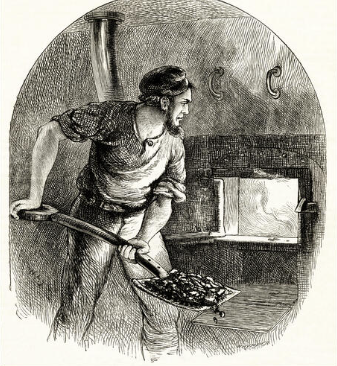
Owen Coughlan (your great great grandfather) immigrated from Ireland to the US at the age of 17 in 1853, at the end of the Great Irish Famine, with a wave of other Irish immigrants searching for a better life. It appears that he didn't travel with other family members, but the record of his immigration was not found. Owen doesn't seem to have had any special trade or skills, and shortly after he arrived a census recorded him working as a servant, which was a common occupation for Irish immigrants. Given his age and lack of skills, Owen probably worked as a houseman for a wealthy household, helping with heavy labor like carrying wood or coal and feeding it into the furnace. He would have earned about $1 per day, but the job also included room and board, which made it attractive to new immigrants.
Owen became a US citizen on December 4, 1861, and shortly after that joined the Massachusetts Infantry, 39th Regiment as a Private. The Civil War was going on, and States were being called on to supply troops. This regiment did not participate in its first battle until July 1863 (Gettysburg) but by that time Owen was discharged because on February 1, 1863 he married Sarah Gillogly in Natick, MA, who had also immigrated from Ireland (1854). We can imagine that life was difficult for Owen and Sarah as they brought 7 children into the world from 1863–1881, living in various addresses in the Chelsea/Revere/Salem area north of Boston. At times, census documents did not list an occupation for Owen, which may suggest that he was unemployed, and at other times, when he was working, it was in a menial job. The picture that emerges is one of him not having steady employment and hopping from one job to another to support his family.
This changed in the 1880's, when Owen plugged into the changing political winds that were blowing through Boston. Boston was a magnet for Irish immigrants in the mid-1800's, but the area was governed by Protestants who discriminated against Irish Catholic immigrants. The Irish were gaining political clout though, in part through the sheer numbers of them immigrating to Boston and also because they were having large families, like Owen and Sarah. For example, Revere, MA, where they were living then, increased in population 4-fold in the 1880's, largely driven by working class Irish immigrants. The Irish immigrants in Boston were beginning to gain political strength, and Revere was a hot bed of this activity.
The 1890 Boston directory lists Owen Coughlan with the occupation of a Sheriff's Keeper. A Sheriff's Keeper is a position paid by the government to a person who looks after company property or monies when that company is bankrupt. In Boston, during this period, this position was a political patronage job that did not require any special skills. It appears to have afforded Owen the first regular paycheck in his 30 years in America, and it lasted into his last decade of life. This change in his financial life must have been a huge relief, and one that his teenage son John D Coughlan (b. 1870) took keen notice of.
How did Owen get this job? We can only assume that he was involved in politics as a "ward boss" or some such neighborhood position that helped get supporters to the polls on election day and directed public funds to neighborhood improvements. His involvement in politics could be a case of him gravitating toward work that he was passionate about, as a vein of social fairness and participation in politics runs through the Coughlan family, even 3 generations later and more than 100 years since. About the same time, Owen demonstrated leadership and organizational skills in another endeavor when he founded and was the first president of Boston Chapter 4 of the Ancient Order of Hibernians, an Irish heritage organization which provided a critical safety net of faith, community, and social support for early Irish immigrants. Maybe leading people was a strength of Owen's, but this newfound career came at a good time to try to help his children secure a better life than he had, through his political connections.
His third son Eugene may have been his first opportunity to use his political connections to help get his son a job, but it ended poorly. In 1893, when Eugene was 30 years old, he was working for the Sheriff in a trusted role like his father's, but Eugene violated that trust and was charged with a crime. The penalty handed down was only a fine, but he lost the job and ended up working for the commuter train company in Revere with his older brother Thomas and living with his brother's family. By 1930, after Thomas died, the census shows Eugene living as a boarder, presumably with little personal property and never having married.
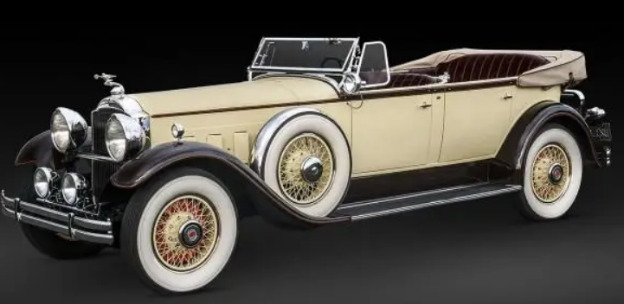
Youngest son Charles Parnell Coughlan was the family's biggest financial success story. He became a realtor working with the Woolworth company as they expanded into the Boston area. His success was apparent by his move from Revere to Brookline, where he relocated his family into a large house at 45 Vernon Street. He also owned a summer house in Scituate and may have been the only member of his family who owned real estate. His family lived well, but he died too soon, at age 52, during the depth of the Great Depression, in what sounds like it may have been a covered-up suicide. Other businessmen took their life during the period following the financial crash of 1929, when they could no longer provide for their families or even pay their debts, and this may have been what happened to Charles. He was discovered by his daughter, Grace, sitting in a running car parked in the garage. His doctor theorized that he had started the car and then gotten out of it to open the garage door when he was stricken by a heart attack. It was further theorized that he then returned to sit in the car without thinking of turning the car's engine off. Carbon monoxide filled the garage and led to his death.
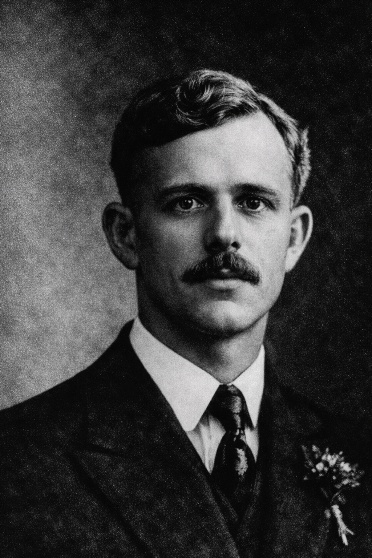
John D Coughlan (your great grandfather) was the fourth child, born in 1870, so he witnessed his father's success in politics during his teenage years. John went to work for the Post Office, and perhaps Owen's connections helped get that job too. In any case, this job gave John a steady income and time to work in politics. In 1912 he was the Finance Committee Chairman of the City of Revere, for example, but he also served on many Revere committees through the years, and because of this his name appears over 100 times in the Revere Journal.
Revere town meetings could get rough and tumble during this time, and political adversaries of John even tried to prevent him from serving as town meeting moderator by claiming his job as a civil servant in the Post Office made him ineligible. In 1912 the issue rose to the attention of US President William Taft, and he threw his support behind John, who was then allowed to continue to serve as moderator of town meetings. This all was during the era of Boston politics, and the rise of Irish political power headlined by James Michael Curley. Oral family history reports that John was in some way associated with Curley. James Curley served 4 terms as mayor of Boston (1914–1950) that transformed Boston politics and the standard of living of the Irish Catholics of Boston. John D Coughlan participated in this political wave.
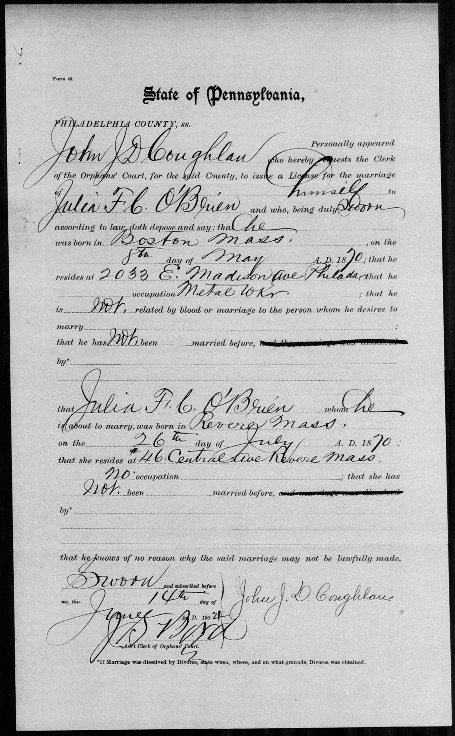
In 1902 John married Julia F O'Brien when the two eloped to Philadelphia, PA. Each of them was 32 years old, and at the time Julia was a bookkeeper who seemed to live in a close-knit family, so the act of eloping seems out of character. We can only speculate as to the reasons and what reception they received at the O'Brien house after returning, but the O'Brien family seemed to welcome John as a family member and in fact helped him throughout their life.
John and Julia had 5 children from 1903–1917, but in 1922 tragedy struck and Julia died of a stroke at age 51, leaving children ranging in ages from 5–19. Many families finding themselves in this situation would never recover from this setback, but the Coughlan family continued to thrive and ended up in a higher station in life than their parents, in large part due to Mary O'Brien, Julia's spinster older sister, who stepped in to raise at least some of the children. The 1930 census shows Mary O'Brien as the head of a household with Raymond (21 years old, your grandfather) and John Jr (23 years old) living with her. Presumably Mary Coughlan (b. 1903) joined the convent around the time of her mother's death to start her life as the nun Sister Florentia. We don't know if the girls (Rita, b. 1914, and Imelda, b. 1917) lived with Mary O'Brien or Sister Florentia in the convent. The latter is most likely, as both are graduates of the Rosary Academy of Watertown, MA, where Sister Florentia taught. Another possibility is that they lived with John Sr. in Belmont, where the 1930 census reported him living as a boarder. The girls are not listed in the census at all, so we can only guess. John Sr. lived to be 80 years old, until he died from an accidental gas leak in his Framingham home, but he is buried in the O'Brien family plot in Malden, MA, with Julia, Mary and their parents — not with his second wife, Marcia, who also died in the accident.
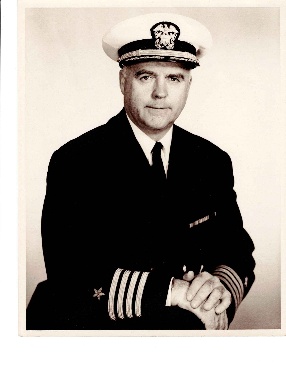
John Jr and Raymond both chose careers in government and were also active in politics like their father and grandfather. John was the superintendent of schools in Canton and Marlboro, MA, and served on the State Youth Service Board, a politically appointed position. Raymond joined the Navy at the beginning of World War II and rose to the rank of Captain during his 30-year career. He was also active on local school boards and even ran for the US House of Representatives after he retired to New Hampshire.
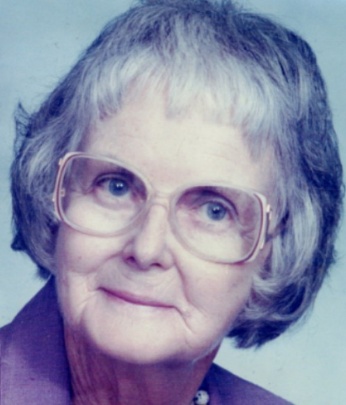
Family legend tells that Marion Hanchay (she dropped Theresa, which was her real first name) caught Raymond's eye while walking home in Boston. Raymond, 10 years her senior, walked with her all the while trying to ask her out on a date. It's told that Marion did her best to discourage him, but somehow this unorthodox approach worked, and they were married in 1943 before Raymond shipped out to the Pacific Ocean — but not before she became pregnant with Jerry (Raymond Jerome Jr). Richard (1946), Jimmy (1949) and Mary (1956) would follow. They would live in Washington DC, East Northport, NY, Rye, NH and Naples, FL. Raymond died a few years after retirement, in 1979, and Marion lived until 2003, long enough to enjoy her children and grandchildren.
Marion (your grandmother) was a Hanchay and daughter of Edward H, who worked for Traveler's Insurance and relocated the family often, early in his career. As a result, his wife, Anna Kelly, is from Connecticut, and each of the children were born in a different state: Marion in Pennsylvania (1919), Edward in Massachusetts (1915) and Raymond (1917) in New York. The insurance industry is successful when it limits claim payments, and Edward H (your great grandfather) was known to be a bit cold — saying "no" for a living probably carried over to his personal life. Kay, his second wife, was your mother's favorite.
Two traits run through the Coughlan family, which are at least partly responsible for them rising from the lowest rungs of society in 1853, quickly surpassing most of the families in the Revere neighborhood they started their American journey from. The first is that they are very intelligent, with a few family members demonstrating exceptional memory skills. Here are some examples of their academic achievements:
- Sister Mary — taught Latin and Physics in Catholic High Schools
- Raymond (your grandfather) — Navy Captain and Aeronautical Engineer. Graduate of Northeastern University. Studied Aeronautical Engineering at MIT.
- John Jr — graduate of Providence College and Harvard Graduate School of Education. Honorary Doctorate from Suffolk University.
- Rita — graduate of Salem State Teachers College. Taught 5th grade for 30 years.
- Imelda — graduate of Fischer Junior College and worked as a legal secretary. She was also a longtime personal assistant to Admiral Arthur W. Radford.
Raymond J (Jerry) and Mary (your mother) both have advanced college degrees as well, and everyone in their generation were knowledge workers, as opposed to being blue-collar laborers like the first Coughlan generations in America.
James (Jimmy) worked as a computer programmer but supported himself for half his life as a self-taught financial trader. He had an exceptional memory and reportedly memorized the East Northport, NY phone book when he was a child. As an adult he loved to play the card game Hearts, and at some point in the game would often pause and recount each card that was played, who played it and who won the trick. Incredible! This gets to the other characteristic that runs through the Coughlan family — competitiveness. Jerry, Richard and Jimmy all competed in high school sports and with each other long after. Family gatherings included competitions in basketball, golf, Trivial Pursuit, Hearts, etc. that were recounted for years and are woven into the fabric of the family. In the generation before them, Raymond and John Jr may have been even better athletes and were just as competitive, if not more.